
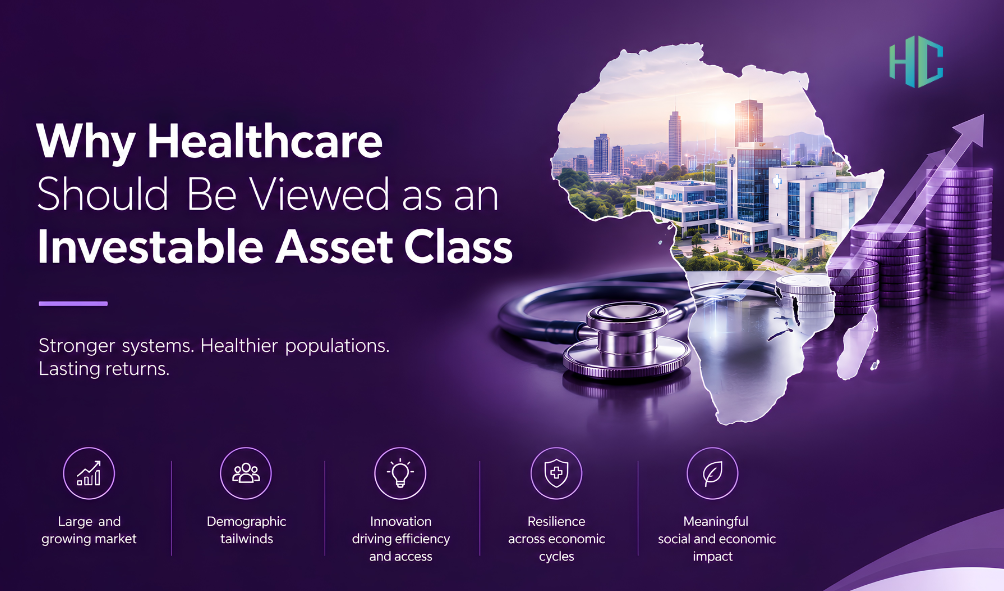
Healthcare is often discussed as a social necessity. It is time to also recognize it as an economic opportunity.
For decades, healthcare in Africa has largely been financed through a combination of government budgets, philanthropy and international development funding. These sources remain important, but they are not sufficient to meet the continent’s growing healthcare needs.
At the same time, Africa is building a new generation of healthcare businesses: diagnostic networks, digital health platforms, pharmaceutical manufacturers, healthcare providers, health-financing companies, medical infrastructure businesses and technology-enabled services.
The question is no longer simply how do we fund healthcare?
It is also:
What would happen if healthcare were treated as an investable asset class in its own right?
This was one of the central questions explored at HealthCap Africa’s Healthcare as an Asset Class: Private Capital Roundtable, held in Lagos on 9 September 2026. This event brought together pension fund managers, regulators, development finance institutions, healthcare investors and operators to examine how more private and institutional capital could flow into Nigerian and African healthcare.
Healthcare is an economic system, not simply a social service
Healthcare affects almost every part of an economy.
A functioning healthcare system keeps people productive. It supports businesses, creates employment, develops specialised industries, generates tax revenue and creates demand for technology, infrastructure, logistics, pharmaceuticals, financial services and professional expertise.
When healthcare systems are underdeveloped, the economic consequences extend well beyond hospitals.
Patients may travel abroad for treatment. Businesses may absorb productivity losses when employees cannot access care. Families may face significant out-of-pocket expenses. Healthcare providers may struggle to obtain financing for expansion. Pharmaceutical supply chains may remain dependent on imports.
These are not only healthcare problems.
They are economic inefficiencies.
This is why healthcare deserves to be considered alongside other sectors that attract long-term investment.
The investment opportunity is bigger than hospitals
When people hear “healthcare investment,” they may immediately think of hospitals and clinics.
But the healthcare economy is considerably broader.
It includes:
- Diagnostics and laboratory networks
- Pharmaceutical manufacturing and distribution
- Digital health infrastructure
- Healthcare payments and financing
- Insurance and risk management
- Medical equipment and supply chains
- Healthcare logistics
- Specialist and primary care delivery
- Health data and information systems
- Workforce and healthcare management platforms
Each of these represents a different investment opportunity, with different risk profiles, capital requirements and potential return structures.
This matters because healthcare does not need one type of capital.
Early-stage venture capital can support a healthtech company developing a new model. Growth capital can help a proven healthcare business expand across markets. Private credit can finance businesses with predictable cash flows and working-capital requirements. Private equity can support consolidation and the development of larger healthcare platforms.
Over time, public markets can provide another pathway for companies that reach significant scale.
The opportunity, therefore, is not simply to put more money into healthcare.
It is to build an entire capital ecosystem around healthcare.
Why now?
The timing of this conversation is particularly important.
Africa’s healthcare financing model is under pressure as governments face fiscal constraints and international development funding becomes less certain. Stakeholders at the HealthCap Africa roundtable therefore discussed the need to strengthen domestic sources of capital, including institutional investors and pension funds.
The roundtable brought together pension fund representatives whose institutions collectively manage more than $5 billion in assets, alongside regulators, development finance institutions, healthcare investors and operators.
This points to an important opportunity.
Africa already has pools of long-term capital.
The challenge is creating the structures, businesses, governance standards, risk frameworks and investment vehicles that can connect that capital to healthcare opportunities.
As Jean Stéphane Koffi, CeMBA, MSc FFI of the Africa Finance Corporation ration highlighted during the roundtable, institutional capital needs structures that enable investors to participate while managing risk, strengthening governance and diversifying exposure.
In other words, capital is only one part of the equation. Investability is the other.
What makes healthcare investable?
For healthcare to attract significant institutional capital, investors need more than evidence of need.
They need businesses with credible revenue models.
They need governance.
They need transparency.
They need measurable performance.
They need management teams capable of executing.
They need regulatory clarity.
And they need investment structures that match the characteristics of the underlying business.
This is particularly important in Africa, where many healthcare businesses are still relatively young.
The opportunity is therefore two-sided.
Investors need to understand healthcare better.
And healthcare businesses need to become more investment-ready.
That means building companies that can move from founder-led businesses into professionally managed, scalable institutions.
It means stronger financial reporting, better governance, clearer unit economics, robust operating systems and disciplined capital allocation.
This is where specialist investors can play an important role.
What other markets can teach us
Healthcare has already become a major investment category in other parts of the world.
HealthCap Africa’s founder and General Partner, Dr. Ola Brown, pointed during the roundtable to the scale of specialist healthcare investing in North America and Europe, where hundreds of dedicated healthcare and life-sciences funds have deployed substantial amounts of capital across the sector.
The example of India is equally instructive.
At the roundtable, Dr. Brown highlighted the growth of healthcare-focused investment platform Quadria Capital, which has built a multi-billion-dollar healthcare investment platform. The broader point was not that Africa should replicate another market exactly, but that sustained private investment can help create the healthcare companies and infrastructure that eventually become significant parts of an economy.
There is a useful question for Africa here:
If other emerging markets can build large healthcare businesses through sustained investment, what could patient African capital build across our own continent?
From healthcare need to investment opportunity
One of the most important shifts is changing how we interpret Africa’s healthcare gaps.
A large unmet need is obviously a public-health challenge.
But it can also indicate substantial market demand.
Millions of people need affordable diagnostics. Providers need financing. Hospitals need technology. Pharmacies need reliable supply chains. Insurers need better data. Patients need easier access to care. Governments need better visibility into health systems.
Every one of these gaps represents a problem.
And well-designed businesses can turn problems into products, services and infrastructure that create both economic and social value.
This is why impact and financial returns should not automatically be viewed as opposing objectives in African healthcare.
When a company makes diagnostics more accessible, supports more healthcare providers, reaches more patients or enables more people to access insurance, those outcomes can represent both impact and evidence of demand.
The investment opportunity lies in finding businesses that can translate that demand into sustainable, scalable enterprises.
This is where HealthCap Africa comes in
HealthCap Africa was built around this thesis.
We invest at the intersection of healthcare, technology and finance, backing early-stage businesses building solutions across healthcare delivery, diagnostics, pharmaceuticals, infrastructure and healthcare financing.
Our role goes beyond writing cheques.
We work with founders to help build stronger businesses, providing capital alongside sector expertise, strategic support, networks and access to the wider investment ecosystem.
These businesses represent something larger than individual investments.
They are building the infrastructure and systems through which healthcare can become more accessible, affordable, efficient and scalable.
And as they grow, they have the potential to become the larger healthcare institutions that Africa needs.
Building the healthcare capital ecosystem
Ultimately, making healthcare an investable asset class is not the responsibility of one investor.
It requires an ecosystem.
Governments have a role in creating enabling policy and regulatory environments.
Regulators have a role in providing clarity and appropriate investor protections.
Healthcare operators have a role in building commercially sustainable businesses.
Founders have a role in creating companies with strong governance and credible economics.
Development finance institutions can help catalyse private capital.
Pension funds and institutional investors can provide long-term capital where appropriate.
And specialist investors can help bridge the gap between innovative healthcare businesses and the capital required to scale them.
The HealthCap Africa roundtable was designed around precisely this idea: bringing different parts of that ecosystem into the same room.
Because Africa does not simply need more healthcare funding.
It needs more healthcare businesses that are investable, scalable and capable of becoming institutions.
The opportunity ahead
Africa’s healthcare challenges are significant. But the scale of the challenge is also a signal of the scale of the opportunity.
The continent needs better diagnostics, stronger pharmaceutical manufacturing, more efficient healthcare delivery, deeper insurance markets, stronger data infrastructure and new models for financing care.
Building these systems will require capital.
But it will also require a change in mindset.
Healthcare should not be viewed only through the lens of expenditure, aid or social need.
It can also be viewed through the lens of enterprise creation, infrastructure, innovation, employment, productivity and long-term investment.
That is the shift HealthCap Africa wants to help advance.
Because when healthcare businesses become stronger, the benefits extend beyond investors and founders.
They reach patients.
They reach healthcare workers.
They reach families.
They reach employers.
They reach governments.
And ultimately, they contribute to building stronger economies.
Healthcare is not simply something Africa needs to spend more on.
It is an asset class Africa can build, invest in and scale.